
Ordering & Shipping PolicyAll products ship from our U.S. warehouse. Items start at $1 each; shipping is $2.50 up to 1 lb, then $1.60 per extra lb to 4 lb, and $0.80 per lb beyond.

Category: Styling & Care

How to wear, store and look after jewellery.

  • Brooch vs Lapel Pin: What’s the Difference?

    Brooch vs Lapel Pin: What’s the Difference?

    A lapel pin is a brooch with a job. The object is the same — a decorative fastener with a pin on the back — but the size, the placement and the purpose are not. A brooch is worn for how it looks; a lapel pin is worn for what it says. Everything below follows from that one difference.

    The short answer

    A lapel pin is a sub-type of brooch, not a separate category. Three things separate them: size (lapel pins are usually 3 cm or less), placement (the jacket lapel, almost always the left side), and purpose (insignia, membership, commemoration, or quiet minimalism rather than decoration). If a piece is under 3 cm and you wear it on a lapel, the two words are interchangeable and nobody is wrong.

    Side-by-side

    Brooch Lapel pin
    Typical size 2.5–8 cm 1–3 cm
    Common backing Safety pin, rollover bar Butterfly clutch, magnetic
    Where it is worn Anywhere on the garment or accessory Left jacket lapel, sometimes the collar
    Purpose Decoration, shape, colour Insignia, membership, memorial, minimal detail
    Typical weight 5–60 g 2–10 g
    Occasion Everyday to formal Formal, business, clubs, ceremonies
    Worn in multiples Yes — a cluster on a coat or scarf Rarely — one per lapel

    What counts as a brooch

    A brooch is jewellery first. It can be worn at the shoulder, the waist, the hip, on a scarf, a hat, a bag strap or a shoe — anywhere the pin can pass through and the weight can be carried. Historically it was a fastener: the fibula held a cloak closed long before it decorated one. That history is why brooches still use a safety pin or a bar, the two backings that actually hold weight.

    Because a brooch is decorative, it is allowed to be large. Our own range runs 1.8–8 cm on the longest edge, with a median of 5 cm, and the heaviest piece is 29.9 g. That is a piece of jewellery, and it is judged like one: by how it sits, how it catches light, whether it pulls the cloth.

    What counts as a lapel pin

    A lapel pin is worn in one place, and usually for one reason. Flags, club crests, campaign badges, commemorative dates, a company mark — the classic lapel pin carries information. That is why it stays small: it has to sit inside the lapel without covering it, and it has to survive being worn repeatedly on the same jacket.

    The backing follows the job. A butterfly clutch holds a thin post that goes through the lapel and disappears behind it, leaving nothing visible from the front. Magnets do the same without a hole. Neither is built to carry weight, which is why lapel pins are light. Ours run 1.7–3.0 cm and 2.3–10 g.

    The overlap: when a small brooch is a lapel pin

    The two categories only separate cleanly above 3 cm. Below that, the same object gets both labels depending on who is selling it and where it is worn.

    Eight of the 71 brooches we have measured are under 3 cm. We list them as brooches because that is how they are designed and photographed, but put one on a suit lapel and any reasonable person would call it a lapel pin. If you are shopping and the listing says either word, check the measurement instead of the label — a 2 cm piece works as a lapel pin whatever the shop calls it, and a 6 cm piece does not, whatever the shop calls it.

    Which one should you wear

    By outfit

    Suit or blazer: a lapel pin, 2–3 cm, on the left lapel, sitting 2–3 cm below the notch. Coat, knitwear, scarf: a brooch, 5 cm and up, because thick cloth needs scale. Shirt or fine blouse: either, but keep it under 2.5 cm or the collar will pull. Denim jacket or tote: a brooch, and more than one is fine — that is where a cluster belongs.

    By occasion

    Business and formal settings reward the lapel pin, because it reads as deliberate and takes up almost no visual space. Weddings and evening wear go either way, depending on the dress code: a small pin for a dark suit, a larger brooch when the outfit is plain enough to carry it. Everyday wear is brooch territory — a lapel pin is too small to register on a jumper.

    Can you wear both at once

    Yes, with one rule: one piece per side. A lapel pin on the left lapel and a brooch at the chest pocket, or on the opposite side, reads as considered. Two pieces on the same lapel reads as an accident. Keep the weights apart as well — a 3 g pin above a 25 g brooch will look like an afterthought, and the heavier piece will drag the lapel out of shape first.

    How to choose in thirty seconds

    If the garment has a lapel, wear a lapel pin. If it does not, wear a brooch. If the piece is under 3 cm and the garment is tailored, the label does not matter. If the piece is over 5 cm, it is a brooch and it needs a garment with enough surface to hold it — our size guide has the measurements and the proportion rules. And if the concern is damage rather than naming, the backing matters more than the category: see how to wear a brooch without damaging clothes.

    Both ends of the range are in stock: lapel pins from 1.7 cm, and brooches up to 8 cm. A few that sit on either side of the line:

    Frequently asked questions

    Is a lapel pin the same as a brooch?

    Technically yes — a lapel pin is a small brooch worn on a jacket lapel. In practice the words signal different things: brooch suggests jewellery and decoration, lapel pin suggests insignia and a formal setting. Nothing breaks if you use either.

    Which side do you wear a lapel pin on?

    The left lapel. Men’s jackets button left over right, which puts the buttonhole on the left lapel, and that is where a pin has traditionally gone. The right lapel is sometimes used for a second pin or a boutonnière, but the left is the default.

    Can a woman wear a lapel pin?

    Yes, on any jacket with a lapel — blazer, suit jacket, coat. The convention is identical: left side, below the notch, no wider than two thirds of the lapel.

    Are brooches in style?

    Brooches move between formal and casual rather than in and out. What changes is size and placement: a small pin on a lapel reads contemporary, a large rhinestone piece on a coat reads vintage. Choosing by proportion rather than by trend is why the size guide exists.

    What is the difference between a brooch and a pin?

    In everyday use, nothing. Both mean a decorative piece with a pin on the back. A lapel pin is simply a small one worn on a lapel, and a brooch is the broader word that covers every size and placement.
  • Brooch Size Guide: How Big Should a Brooch Be?

    Brooch Size Guide: How Big Should a Brooch Be?

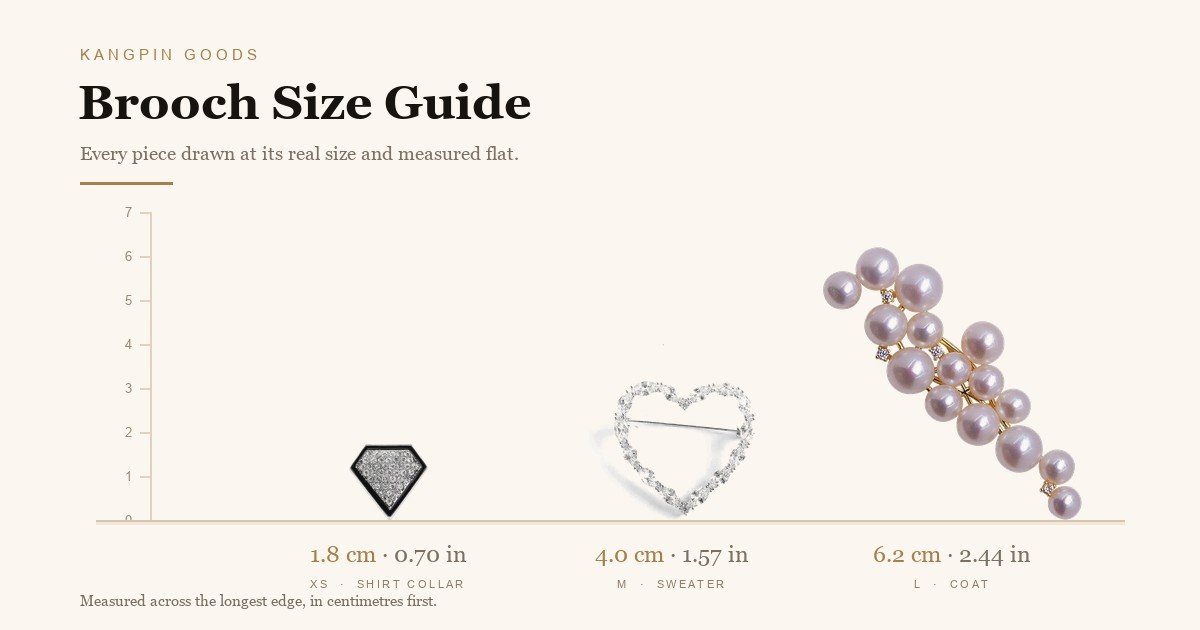
    A brooch should take up about a third of the lapel it sits on, and never more than two thirds. On a standard 7–9 cm blazer lapel that puts the sweet spot at 2.5–3 cm and the ceiling at 6 cm. On a coat, 4–6 cm looks right. Anything past 8 cm stops being a detail and becomes the outfit. Every number below comes from 76 pieces we measured by hand, not from a supplier sheet.

    The short answer

    Lapel pins run 1.5–3 cm. Everyday brooches run 3–5 cm. Coat brooches run 5–8 cm. Above 8 cm you are wearing a statement piece and the garment has to be plain enough to carry it. If you only remember one rule: the brooch should not be wider than two thirds of the lapel, and it should not be heavier than the fabric can hold without sagging.

    • Collar, shirt, fine knit — 1.5–2.5 cm. Anything larger drags the collar out of shape.
    • Blazer, cardigan, jacket — 2.5–4 cm. The safe everyday range.
    • Coat, heavy sweater — 4–6 cm. Where a brooch starts reading from across a room.
    • Scarf, bag, hat — 6–8 cm. Accessories carry size better than cloth does.

    The five size bands

    We sort every piece by its longest edge, measured flat. The bands below are what the numbers actually fall into across our range, not a theoretical scale.

    Band Longest edge Inches About the size of Wear it on
    XS 1.5–2.5 cm 0.6–1.0 in A dime to a quarter Shirt collar, fine knit, scarf
    S 2.5–4 cm 1.0–1.6 in A postage stamp Blazer lapel, cardigan
    M 4–6 cm 1.6–2.4 in A business card, folded Coat, sweater, everyday
    L 6–8 cm 2.4–3.1 in Your palm without fingers Heavy coat, scarf, bag
    XL 8 cm and up 3.1 in and up A credit card, widthwise Statement looks, plain heavy cloth

    Two reference objects make this usable without a ruler. A US quarter is 2.43 cm across; a credit card is 8.56 cm wide. Put the brooch on a card and you can judge its band instantly.

    What each size looks like on a lapel

    The lapel is the hardest working surface a brooch has, and the one where oversizing shows first. A standard men’s blazer lapel is 7–9 cm at its widest; a women’s tailored jacket often runs narrower, 5.5–7 cm.

    Divide the lapel width by three and multiply by two. On an 8 cm lapel the ceiling is 5.3 cm — comfortably inside our M band. On a 6 cm lapel the ceiling is 4 cm, which puts most of the M band off limits and makes S the practical choice. A brooch that reaches the lapel edge does not look generous, it looks like it was pinned on by mistake.

    Height matters too. Place the pin so its centre sits 2–3 cm below the lapel notch, not level with it. Level with the notch, a large brooch competes with the collar; below it, the same brooch reads as deliberate.

    Real measurements from our range

    These are actual pieces from our brooch collection, measured flat with a steel rule. We list the longest edge, the weight of a single piece, and the band it falls into.

    Piece Longest edge Inches Weight Band
    Gold Rose Lapel Pin 1.7 cm 0.66 in 4.1 g XS
    Black Rose Lapel Pin 1.7 cm 0.66 in 4.1 g XS
    Rhinestone Cross Lapel Pin 2.6 cm 1.02 in 2.3 g S
    Gold Starburst Pin 3.0 cm 1.18 in 5.0 g S
    Citrine Fan Brooch 3.0 cm 1.18 in 10.0 g S
    Gold Bird Brooch 3.0 cm 1.18 in 24.9 g S
    Silver Rhinestone Flower 5.0 cm 1.97 in 15.9 g M
    Ruby Crystal Flower 5.0 cm 1.97 in 15.9 g M
    2-Pack Pearl Bow Brooch 6.0 cm 2.36 in 20.0 g L
    Pink Pearl Branch 6.2 cm 2.44 in 24.9 g L
    Gold Knot Brooch 6.3 cm 2.48 in 7.3 g L
    Gold Leaf Branch 8.0 cm 3.14 in 6.8 g XL

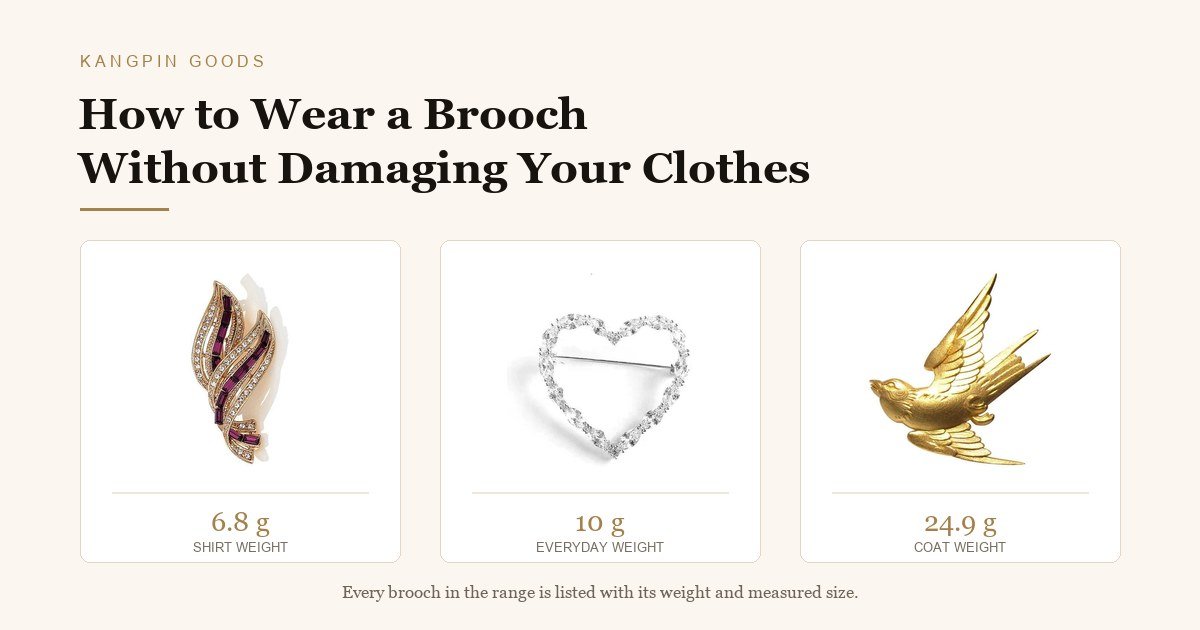
    Read down the weight column and something useful appears: size and weight are not the same axis. Our 3 cm gold bird weighs 24.9 g — more than twice our 8 cm leaf branch at 6.8 g. The bird is a solid casting; the branch is openwork wire. If you buy by size alone you will put a heavy piece on a soft blouse and wonder why it droops.

    Size tells you how much room the brooch takes up. Weight tells you which fabric can carry it. You need both numbers, and most shops publish neither. If the pin itself worries you more than the size, our guide to wearing a brooch without damaging clothes covers backings and fabric by fabric.

    Proportion rules

    Lapel width

    Two thirds of the lapel, maximum. That is the single most reliable rule in this guide because it scales with the garment instead of with fashion. A wide 1970s lapel can take an 8 cm piece that would swallow a modern slim one.

    Collar and neckline

    On a shirt collar or a crew neck, keep the brooch under 3 cm. Above that, the pin’s weight pulls the collar away from the neck and you get a gap on the opposite side. On a V-neck, place the brooch where the two edges meet — the point is structurally the strongest spot on the garment.

    Body frame and height

    Scale to the torso, not to a chart. As a starting point: under 160 cm, the M band is your outer limit for a lapel; over 175 cm, L sits in proportion where M looks small. This is about visual balance, not permission — a small person can wear an XL piece, it simply becomes the whole outfit rather than a detail.

    Size by occasion

    Occasion Band Why
    Office, interviews S (2.5–4 cm) Reads as attention to detail without announcing itself
    Wedding, formal S to M Photographs well; anything larger catches flash and blows out
    Everyday, errands M (4–6 cm) The band most of our range sits in, for good reason
    Winter coat L (6–8 cm) Thick cloth eats small details
    Scarf, tote, hat L to XL Accessories are seen from further away
    Evening, statement XL (8 cm+) One piece, plain garment, nothing else competing

    How we measure

    Every piece is laid flat on a steel rule and measured across its longest edge, from the outer tip of one end to the outer tip of the other. That is not the same as the diagonal of a bounding box, which is why our numbers sometimes read smaller than a supplier’s. We record centimetres first and convert to inches, keeping two decimals, because the centimetre measurement is the one taken by hand.

    Weight is the finished piece with its backing, in grams, converted from the scale reading in pounds. Two-piece sets are weighed together and divided, so the number you see is one brooch — not the pair. Of the 79 brooches and 6 lapel pins we currently sell, 76 are measured this way; the remaining 9 have no size listed rather than an estimate.

    Frequently asked questions

    What size brooch is too big?

    Past two thirds of the lapel width, or past 8 cm on any garment. At that point the brooch is no longer a detail and the rest of the outfit has to be plain enough to support it. On a 8 cm lapel that ceiling is about 5.3 cm.

    Is a 5 cm brooch too large for a blazer?

    No, provided the lapel is at least 7.5 cm wide. A 5 cm piece on a standard 8 cm lapel takes up just under two thirds of the width, which is the upper limit but still comfortable. On a narrow 6 cm lapel it is too much — drop to 4 cm.

    What size lapel pin should a man wear?

    2–3 cm for a suit, 1.5–2 cm if the lapel is narrow or the jacket is double-breasted, where the lapels already carry a lot of visual weight. Our own lapel pins run 1.7–3.0 cm, which is the conventional range.

    How do I know the size before ordering online?

    Put a coin next to the photo. A US quarter is 2.43 cm across, a penny 1.9 cm, and a credit card is 8.56 cm wide. Any listing that gives a measurement in centimetres can be checked against one of those three in a second.

    Does a bigger brooch weigh more?

    Not reliably. Our 3 cm gold bird is 24.9 g and our 8 cm gold leaf branch is 6.8 g — the small one is nearly four times heavier. Solid castings outweigh openwork pieces whatever their footprint. Check both numbers before you decide where a piece can be worn.

    What is the most common brooch size?

    In our range it is 4–6 cm: 36 of the 76 measured pieces fall in that band, and the median longest edge across everything is 4.8 cm. That matches what most people reach for when they are buying their first brooch.

  • How to Wear a Brooch Without Damaging Your Clothes

    How to Wear a Brooch Without Damaging Your Clothes

    A brooch leaves a hole when three things line up badly: a sharp backing, a fabric that cannot close behind the pin, and more weight than the cloth can carry. Change any one of the three and the mark becomes temporary, or never happens at all. The damage is usually decided before the brooch touches the garment.

    The short answer

    Match the backing to the fabric, then match the weight to the backing. A safety pin on wool is fine. The same pin on silk is a hole. A magnetic back leaves nothing behind, but only holds a light piece. Under 10 g will sit on a shirt, 20 g wants a jacket, and 30 g needs a coat or a bag.

    • Backing — how the pin closes decides whether the hole closes with it.
    • Fabric — tight weaves recover, loose weaves do not, coated cloth never does.
    • Weight — a heavy brooch pulls the hole open as you move, even if the pin was fine.

    The backing decides whether you get a hole

    Four backings cover almost everything sold today. They fail in different ways, and only one of them is genuinely hole-free.

    Safety-pin back

    A single pin runs through the cloth and closes behind it. It is the most secure option and the one most likely to leave a permanent mark: the fibres are pushed apart rather than cut, and knitwear will not knit itself back together. Excellent on wool, denim, felt and leather. Risky on silk, chiffon and anything with a visible weave.

    Rollover and bar pins

    Instead of one point, a horizontal bar carries the pin. The load spreads along the bar rather than pulling at a single point, so a light fabric does not tear open around the pin as you move. It still makes a hole — it makes a hole that stays the same size.

    Butterfly clutch

    Two small metal wings on a straight post. Common on lapel pins because the post is thin. On a silk blouse, put a small felt pad behind the fabric: the post itself is fine, but a thin weave will tear around it under the brooch’s own weight when you lean forward.

    Magnetic back

    No hole at all — two magnets, one on each side of the cloth. It only holds what it can grip. Above roughly 15 g the front half starts to slide down the garment through the day, and on a loose knit the magnet will find the gaps. One serious warning: anyone with a pacemaker or an implanted device should not wear a magnetic brooch. The magnets are strong enough to matter.

    Backing Best on Hole risk Weight it holds
    Safety pin Wool, denim, felt, leather High — permanent on knits Any
    Rollover / bar Cotton, linen, blazers Medium — stays one size Up to ~30 g
    Butterfly clutch Lapels, collars, fine shirting Medium — tears thin weaves Up to ~15 g
    Magnetic Heavy weaves, scarves, bags None Up to ~15 g

    Which fabrics survive a pin — and which do not

    Fabric matters more than most guides admit. The same 8 g brooch that disappears into a coat will leave a mark on a silk blouse that no iron will lift.

    Fabric Can you pin it? Where to pin What to put behind it
    Knit sweater Yes, with care Along an existing seam or placket Nothing, but keep it under 15 g
    Wool coat Yes — best case Lapel, chest, pocket edge Nothing
    Silk Yes, with a pad Collar band, never the body Small felt square
    Chiffon Barely Only at a seam or a gathered edge Two layers of interfacing
    Linen Yes Anywhere, but it creases around the pin Nothing
    Denim Yes Pocket, yoke, waistband Nothing
    Leather Yes, once Where you intend to keep it Nothing — the hole never closes
    Coated waterproof No — The coating splits and cannot be repaired
    Fine mesh / tulle No — Use a magnetic back or sew a patch behind

    The weight rule: 10 g, 20 g, and where we stop

    Every brooch we sell has its weight on the listing, so we can be specific rather than vague. Across the 79 brooches in our range, the lightest is 6.4 g, the heaviest single piece is 29.9 g, and the median is 11.1 g. Thirty-eight of the 79 come in under 10 g. Not one is over 30 g.

    Weight Pieces in our range Wear it on Example
    Under 10 g 38 of 79 Shirts, fine knits, silk with a pad, scarves Silver Swallow Brooch — 6.4 g, 5 × 5 cm
    10–20 g 29 of 79 Cotton tees, cardigans, blazers, most everyday wear Heart Outline Pin — 10 g, 4 × 3.9 cm
    20–30 g 12 of 79 Wool coats, heavy knits, denim, canvas bags Crystal Swan Brooch — 24.9 g, 4.2 × 3.5 cm
    Over 30 g None in stock Coats, hats, bags — never a shirt or a thin knit —

    We do not stock anything above 30 g, so we are not going to invent examples to fill that row. If you already own a heavy vintage piece in the 40 g range, treat it as outerwear only: a coat, a hat, a canvas bag, a heavy scarf. On a shirt it will pull open the hole every time you raise your arm.

    There is a second weight number worth knowing. A two-piece set is not twice the wear risk if you only ever wear one at a time — but the listed weight is for the pair. A 59.9 g two-pack is two 30 g brooches, not one 60 g one. Check the pack count before you plan the outfit.

    Five ways to attach a brooch with no visible hole

    1. Pin into a seam. Every knit has a placket, a shoulder seam or a side seam. A pin that goes through the seam disappears into a line that was already there. This is the single most effective trick on knitwear.
    2. Pad the inside. A 3 cm square of wool felt behind the fabric gives the pin something to grip that is not your blouse. The post goes through the felt, not through the weave.
    3. Work from the inside out. Push the pin out through the cloth, then bring it back in through a fold or a pleat. Both entry points sit in shadow, and a fold closes over the thread far better than flat cloth does.
    4. Use a hole that already exists. Buttonholes, belt loops, the top of a pocket, a cuff opening. A pin through a buttonhole leaves nothing new behind.
    5. Switch to magnetic — if the piece is light enough. Under 15 g on a heavy weave, a magnetic back is genuinely damage-free. On anything lighter or looser, it will slide.

    Where to place it so the fabric does not pull

    Lapel and shoulder

    The left lapel is the convention, and it is also the most structurally sound place on a jacket: interfacing sits behind it, so the pin has something to bite. Keep the brooch within two thirds of the lapel width. A 4 cm brooch on a 7 cm lapel looks intentional; a 7 cm brooch on the same lapel looks like it is about to fall off.

    Waist and hip

    Good for heavier pieces because the fabric there is under less tension than across the chest. Pin at the waistband of a skirt or the top of a hip pocket, never across a stretch panel.

    Scarf, hat and bag

    This is where a 25–30 g brooch earns its weight. Felt, wool and canvas all recover better than garment fabric, and a bag strap takes load without tearing. Avoid pinning a scarf at the point where it knots — that is exactly where the fibres are already under strain.

    If the pin snags or leaves a mark

    Do not pull. A snag is one thread pulled out of line; pulling it turns a two-second fix into a repair job. Push the loop back through to the wrong side with a needle, from the front, following the thread’s own path. On a knit, a fine crochet hook does the same job faster.

    A hole in wool will often close by itself: dampen the spot, rub the fibres gently against each other, and let it dry flat. On cotton, steam it from the inside. On silk, do not use water — a water mark on silk is harder to remove than the pin hole. Take it to a dry cleaner and say what happened.

    Storing brooches so the backs stay straight

    A bent pin is the most common reason a brooch starts leaving bigger holes than it used to. Store them flat and separate — a jewellery roll, a lined box, or a strip of felt on a hanger. Do not pile them in a dish, do not hang anything heavy from the pin, and do not seal them in a plastic bag: alloy and silver-tone pieces oxidise faster in trapped damp air than in open air.

    Frequently asked questions

    Does a brooch always leave a hole?

    No. A magnetic back leaves nothing, and a pin through an existing seam or buttonhole leaves nothing new. What leaves a hole is a pin through flat cloth — the fibres separate, and whether they close again depends on the weave. Wool closes, silk does not, coated fabric never does.

    Can you wear a brooch on a silk blouse?

    Yes, with two changes: put a small felt pad behind the fabric, and pin at the collar band rather than the body of the blouse. Silk is strong in the thread and weak in the weave — it will hold a pin, but it will not heal around one.

    How do you wear a brooch on a knit sweater without stretching it?

    Pin along a seam or the button placket, and keep the piece under 15 g. A knit is a loop structure: a pin pushed between loops opens a gap, and the weight of the brooch keeps that gap open as you move. Put it on a line that is already structural and the gap has nowhere to grow.

    Are magnetic brooches safe for all fabrics?

    For the fabric, yes — magnets do not pierce anything. The limitation is weight, not cloth: above roughly 15 g the front slides down through the day. They are not safe for anyone with a pacemaker or an implanted device, regardless of fabric.

    Can a brooch be worn on a coat that is dry-clean only?

    Yes. A pin hole is not a stain, and dry cleaning will not make it worse. Just tell the cleaner the pin was there, so they do not press a crease through the spot. Take the brooch off before the coat goes in the bag.

    Choosing the piece is the other half of the problem. Our brooch collection lists the weight and the measured size on every page — the Gold Rose Outline at 9.5 g is a shirt piece, the Pearl Cascade Bow at 19.1 g is a blazer piece, and the Gold Bird at 24.9 g is a coat piece. The lapel pins are the small end of the same range: under 3 cm, made for a jacket buttonhole or a shirt collar. If the question is how large a piece should be rather than how heavy, the brooch size guide covers that with the same measured data — and if you are unsure whether a small piece is a brooch or a lapel pin, the difference is explained here.