
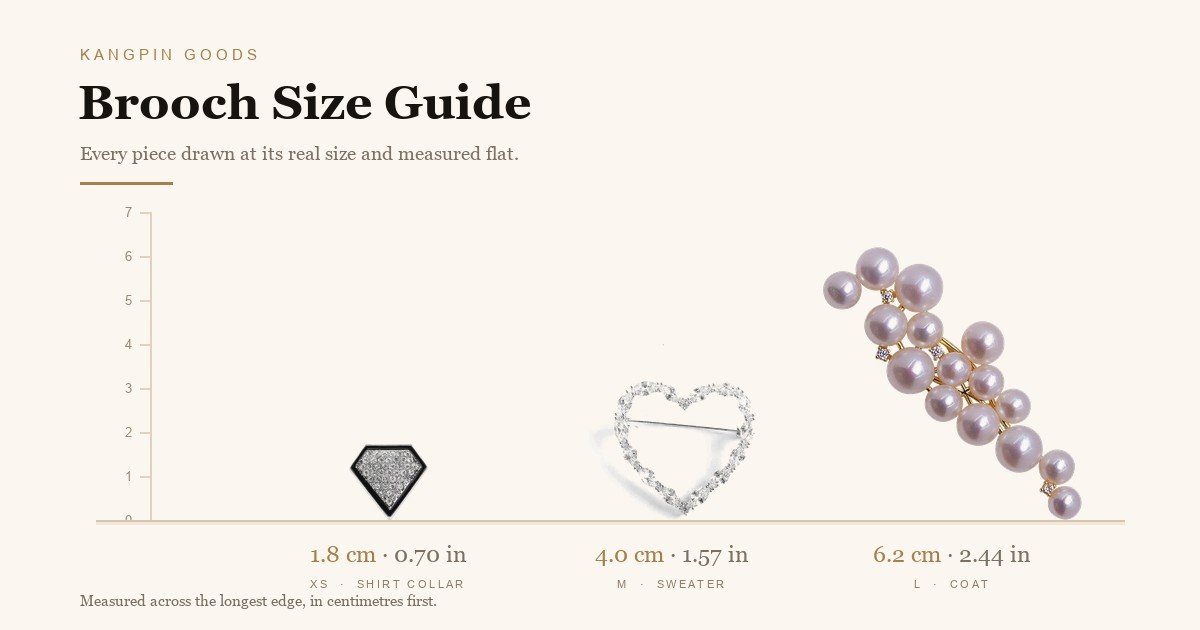
A brooch should take up about a third of the lapel it sits on, and never more than two thirds. On a standard 7–9 cm blazer lapel that puts the sweet spot at 2.5–3 cm and the ceiling at 6 cm. On a coat, 4–6 cm looks right. Anything past 8 cm stops being a detail and becomes the outfit. Every number below comes from 76 pieces we measured by hand, not from a supplier sheet.
The short answer
Lapel pins run 1.5–3 cm. Everyday brooches run 3–5 cm. Coat brooches run 5–8 cm. Above 8 cm you are wearing a statement piece and the garment has to be plain enough to carry it. If you only remember one rule: the brooch should not be wider than two thirds of the lapel, and it should not be heavier than the fabric can hold without sagging.
- Collar, shirt, fine knit — 1.5–2.5 cm. Anything larger drags the collar out of shape.
- Blazer, cardigan, jacket — 2.5–4 cm. The safe everyday range.
- Coat, heavy sweater — 4–6 cm. Where a brooch starts reading from across a room.
- Scarf, bag, hat — 6–8 cm. Accessories carry size better than cloth does.
The five size bands
We sort every piece by its longest edge, measured flat. The bands below are what the numbers actually fall into across our range, not a theoretical scale.
| Band | Longest edge | Inches | About the size of | Wear it on |
|---|---|---|---|---|
| XS | 1.5–2.5 cm | 0.6–1.0 in | A dime to a quarter | Shirt collar, fine knit, scarf |
| S | 2.5–4 cm | 1.0–1.6 in | A postage stamp | Blazer lapel, cardigan |
| M | 4–6 cm | 1.6–2.4 in | A business card, folded | Coat, sweater, everyday |
| L | 6–8 cm | 2.4–3.1 in | Your palm without fingers | Heavy coat, scarf, bag |
| XL | 8 cm and up | 3.1 in and up | A credit card, widthwise | Statement looks, plain heavy cloth |
Two reference objects make this usable without a ruler. A US quarter is 2.43 cm across; a credit card is 8.56 cm wide. Put the brooch on a card and you can judge its band instantly.
What each size looks like on a lapel
The lapel is the hardest working surface a brooch has, and the one where oversizing shows first. A standard men’s blazer lapel is 7–9 cm at its widest; a women’s tailored jacket often runs narrower, 5.5–7 cm.
Divide the lapel width by three and multiply by two. On an 8 cm lapel the ceiling is 5.3 cm — comfortably inside our M band. On a 6 cm lapel the ceiling is 4 cm, which puts most of the M band off limits and makes S the practical choice. A brooch that reaches the lapel edge does not look generous, it looks like it was pinned on by mistake.
Height matters too. Place the pin so its centre sits 2–3 cm below the lapel notch, not level with it. Level with the notch, a large brooch competes with the collar; below it, the same brooch reads as deliberate.
Real measurements from our range
These are actual pieces from our brooch collection, measured flat with a steel rule. We list the longest edge, the weight of a single piece, and the band it falls into.
| Piece | Longest edge | Inches | Weight | Band |
|---|---|---|---|---|
| Gold Rose Lapel Pin | 1.7 cm | 0.66 in | 4.1 g | XS |
| Black Rose Lapel Pin | 1.7 cm | 0.66 in | 4.1 g | XS |
| Rhinestone Cross Lapel Pin | 2.6 cm | 1.02 in | 2.3 g | S |
| Gold Starburst Pin | 3.0 cm | 1.18 in | 5.0 g | S |
| Citrine Fan Brooch | 3.0 cm | 1.18 in | 10.0 g | S |
| Gold Bird Brooch | 3.0 cm | 1.18 in | 24.9 g | S |
| Silver Rhinestone Flower | 5.0 cm | 1.97 in | 15.9 g | M |
| Ruby Crystal Flower | 5.0 cm | 1.97 in | 15.9 g | M |
| 2-Pack Pearl Bow Brooch | 6.0 cm | 2.36 in | 20.0 g | L |
| Pink Pearl Branch | 6.2 cm | 2.44 in | 24.9 g | L |
| Gold Knot Brooch | 6.3 cm | 2.48 in | 7.3 g | L |
| Gold Leaf Branch | 8.0 cm | 3.14 in | 6.8 g | XL |
Read down the weight column and something useful appears: size and weight are not the same axis. Our 3 cm gold bird weighs 24.9 g — more than twice our 8 cm leaf branch at 6.8 g. The bird is a solid casting; the branch is openwork wire. If you buy by size alone you will put a heavy piece on a soft blouse and wonder why it droops.
Size tells you how much room the brooch takes up. Weight tells you which fabric can carry it. You need both numbers, and most shops publish neither. If the pin itself worries you more than the size, our guide to wearing a brooch without damaging clothes covers backings and fabric by fabric.
Proportion rules
Lapel width
Two thirds of the lapel, maximum. That is the single most reliable rule in this guide because it scales with the garment instead of with fashion. A wide 1970s lapel can take an 8 cm piece that would swallow a modern slim one.
Collar and neckline
On a shirt collar or a crew neck, keep the brooch under 3 cm. Above that, the pin’s weight pulls the collar away from the neck and you get a gap on the opposite side. On a V-neck, place the brooch where the two edges meet — the point is structurally the strongest spot on the garment.
Body frame and height
Scale to the torso, not to a chart. As a starting point: under 160 cm, the M band is your outer limit for a lapel; over 175 cm, L sits in proportion where M looks small. This is about visual balance, not permission — a small person can wear an XL piece, it simply becomes the whole outfit rather than a detail.
Size by occasion
| Occasion | Band | Why |
|---|---|---|
| Office, interviews | S (2.5–4 cm) | Reads as attention to detail without announcing itself |
| Wedding, formal | S to M | Photographs well; anything larger catches flash and blows out |
| Everyday, errands | M (4–6 cm) | The band most of our range sits in, for good reason |
| Winter coat | L (6–8 cm) | Thick cloth eats small details |
| Scarf, tote, hat | L to XL | Accessories are seen from further away |
| Evening, statement | XL (8 cm+) | One piece, plain garment, nothing else competing |
How we measure
Every piece is laid flat on a steel rule and measured across its longest edge, from the outer tip of one end to the outer tip of the other. That is not the same as the diagonal of a bounding box, which is why our numbers sometimes read smaller than a supplier’s. We record centimetres first and convert to inches, keeping two decimals, because the centimetre measurement is the one taken by hand.
Weight is the finished piece with its backing, in grams, converted from the scale reading in pounds. Two-piece sets are weighed together and divided, so the number you see is one brooch — not the pair. Of the 79 brooches and 6 lapel pins we currently sell, 76 are measured this way; the remaining 9 have no size listed rather than an estimate.
Frequently asked questions
What size brooch is too big?
Past two thirds of the lapel width, or past 8 cm on any garment. At that point the brooch is no longer a detail and the rest of the outfit has to be plain enough to support it. On a 8 cm lapel that ceiling is about 5.3 cm.
Is a 5 cm brooch too large for a blazer?
No, provided the lapel is at least 7.5 cm wide. A 5 cm piece on a standard 8 cm lapel takes up just under two thirds of the width, which is the upper limit but still comfortable. On a narrow 6 cm lapel it is too much — drop to 4 cm.
What size lapel pin should a man wear?
2–3 cm for a suit, 1.5–2 cm if the lapel is narrow or the jacket is double-breasted, where the lapels already carry a lot of visual weight. Our own lapel pins run 1.7–3.0 cm, which is the conventional range.
How do I know the size before ordering online?
Put a coin next to the photo. A US quarter is 2.43 cm across, a penny 1.9 cm, and a credit card is 8.56 cm wide. Any listing that gives a measurement in centimetres can be checked against one of those three in a second.
Does a bigger brooch weigh more?
Not reliably. Our 3 cm gold bird is 24.9 g and our 8 cm gold leaf branch is 6.8 g — the small one is nearly four times heavier. Solid castings outweigh openwork pieces whatever their footprint. Check both numbers before you decide where a piece can be worn.
What is the most common brooch size?
In our range it is 4–6 cm: 36 of the 76 measured pieces fall in that band, and the median longest edge across everything is 4.8 cm. That matches what most people reach for when they are buying their first brooch.